

Introduction
Machine learning is changing the way we live, work, and make decisions every day. From video recommendations to voice assistants and online shopping suggestions, this technology quietly works behind the scenes. For beginners, the topic may feel complex or technical at first. However, with the right explanation, it becomes much easier to understand and apply.
Machine learning is not magic, and it is not limited to experts with advanced degrees. In simple terms, it helps computers learn from data and improve over time without being directly programmed for every task. Because of this ability, businesses, researchers, and developers use it to solve real world problems faster and more accurately.
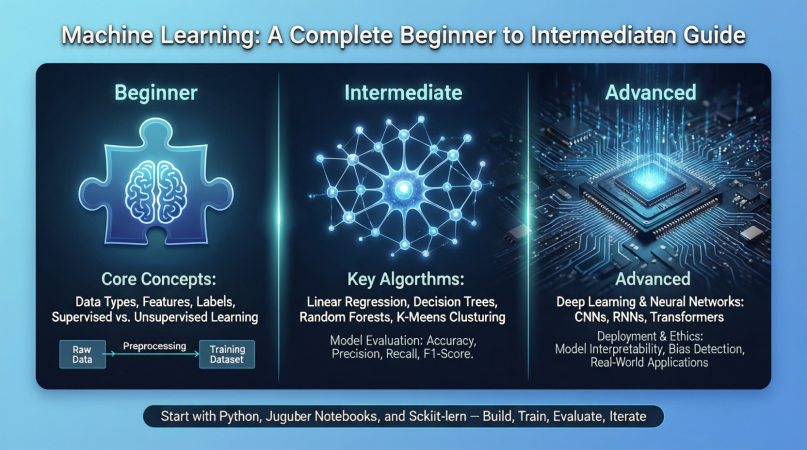
This guide is written for beginners and intermediate readers who want clear and practical knowledge. You will learn what machine learning is, why it matters, and how it works step by step. In addition, the article explains benefits, risks, common mistakes, and expert tips to help you move forward with confidence.
The goal is to make machine learning simple, friendly, and useful. By the end, you will understand the core ideas and feel ready to explore further or even start learning it as a skill.
What is Machine Learning?
Machine learning is a branch of computer science that focuses on teaching machines to learn from data. Instead of following fixed rules, systems analyze patterns and make decisions based on examples.
For example, when you mark emails as spam, the system learns from your actions. Over time, it becomes better at filtering unwanted messages. This learning process happens automatically using data and algorithms.
There are three main types of machine learning.
Supervised learning uses labeled data to train models.
Unsupervised learning finds patterns in unlabeled data.
Reinforcement learning learns through rewards and penalties.
Each type serves different purposes, but all aim to help machines improve performance through experience.
Why is Machine Learning Important?
Machine learning is important because it helps handle large amounts of data efficiently. Humans cannot analyze millions of records quickly, but machines can.
It also improves accuracy and consistency. Systems can reduce human error and make predictions based on facts rather than guesses.
Another reason is automation. Many repetitive tasks can now be handled by intelligent systems, saving time and resources.
Finally, machine learning supports innovation. It enables new products, smarter services, and better decision making across industries like healthcare, finance, education, and marketing.
Detailed Step-by-Step Guide
Step 1: Understand the Problem
Every machine learning project starts with a clear problem. You must know what you want to predict or improve.
For example, do you want to predict house prices or recommend products? A clear goal guides the entire process.
Step 2: Collect Relevant Data
Data is the foundation of machine learning. Without quality data, results will be poor.
Data can come from databases, surveys, sensors, or user activity. It must be relevant, accurate, and sufficient.
Step 3: Prepare and Clean Data
Raw data is often messy. It may contain errors, missing values, or duplicates.
Data cleaning involves removing mistakes and organizing information. This step improves model performance and reliability.
Step 4: Choose the Right Algorithm
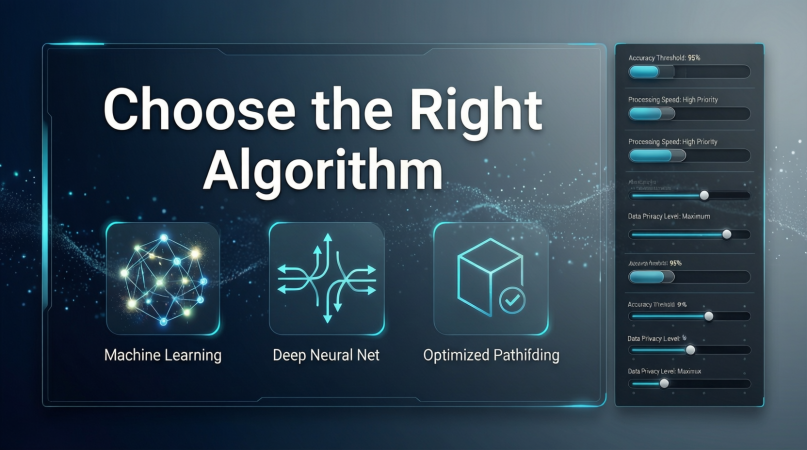
Different problems require different algorithms. Some are good for classification, while others handle prediction or clustering.
Common algorithms include linear regression, decision trees, and neural networks. The choice depends on the task and data size.
Step 5: Train the Model
Training means feeding data into the algorithm so it can learn patterns.
During this phase, the model adjusts its parameters to reduce errors and improve accuracy.
Step 6: Evaluate Performance
After training, the model must be tested using new data.
Evaluation metrics like accuracy, precision, and recall help measure performance and identify weaknesses.
Step 7: Improve and Optimize
Rarely does a model perform perfectly on the first try. Adjustments are often needed.
You can improve results by tuning parameters, adding data, or selecting a better algorithm.
Step 8: Deploy the Model
Once satisfied, the model can be used in real applications.
Deployment allows the system to make predictions or decisions in real time.
Step 9: Monitor and Update
Machine learning models need regular monitoring.
As data changes, models may lose accuracy, so updates are essential for long term success.
Benefits of Machine Learning
- Automates repetitive tasks and saves time
- Improves decision making with data driven insights
- Handles large and complex datasets efficiently
- Learns and improves over time
- Supports innovation across industries
- Reduces human error in predictions
- Enables personalized user experiences
Disadvantages / Risks
- Requires large amounts of quality data
- Can be expensive to develop and maintain
- Risk of biased results due to poor data
- Lack of transparency in complex models
- Security and privacy concerns
- Dependence on technical expertise
Common Mistakes to Avoid
One common mistake is using poor quality data. Even the best algorithm fails with bad input.
Another issue is choosing the wrong algorithm for the problem. Simpler models often work better for basic tasks.
Overfitting is also a frequent problem. This happens when a model performs well on training data but poorly on new data.
Ignoring evaluation metrics is risky. Without proper testing, results can be misleading.
Finally, skipping regular updates can reduce accuracy over time as data patterns change.
FAQs
What skills are needed to learn machine learning?
Basic math, statistics, and programming knowledge help a lot. Logical thinking and problem solving are also important.
Is machine learning difficult for beginners?
It may seem challenging at first, but with simple explanations and practice, beginners can learn it step by step.
How long does it take to learn machine learning?
Learning basics may take a few months. Mastery depends on practice, projects, and continuous learning.
What industries use machine learning the most?
Healthcare, finance, marketing, education, and transportation widely use machine learning solutions.
Can machine learning work without data?
No, data is essential. Models learn patterns only through examples and historical information.
Is machine learning the same as artificial intelligence?
Machine learning is a part of artificial intelligence. It focuses on learning from data, while AI is a broader concept.
Expert Tips & Bonus Points
Start with simple projects to build confidence. Small wins help you understand concepts better.
Focus on data quality before model complexity. Clean data often matters more than advanced algorithms.
Practice regularly using real datasets. Experience improves understanding faster than theory alone.
Stay updated with trends and tools, but master fundamentals first.
Collaborate with others to gain new perspectives and avoid common mistakes.
Document your work clearly. Good documentation helps with learning and future improvements.
Conclusion
Machine learning is no longer a futuristic concept. It is already shaping daily life and business decisions across the world. By learning its basics, you gain insight into how modern technology works and how data turns into value.
For beginners, the key is to start small and stay consistent. Understanding concepts like data, algorithms, and evaluation builds a strong foundation. Intermediate learners can focus on improving models, exploring real use cases, and avoiding common mistakes.
Machine learning rewards curiosity and patience. It encourages experimentation, learning from errors, and continuous improvement. While challenges like data quality and bias exist, careful planning and ethical practices reduce risks.
As industries continue to adopt intelligent systems, knowledge of machine learning becomes a valuable skill. Whether you aim to build a career, improve a business process, or simply understand modern technology, learning this field is a smart step forward. With the right approach, machine learning becomes not only understandable but also practical and empowering.
